
Where Should You Pile Plowed Snow to Prevent Flooding and Property Damage?
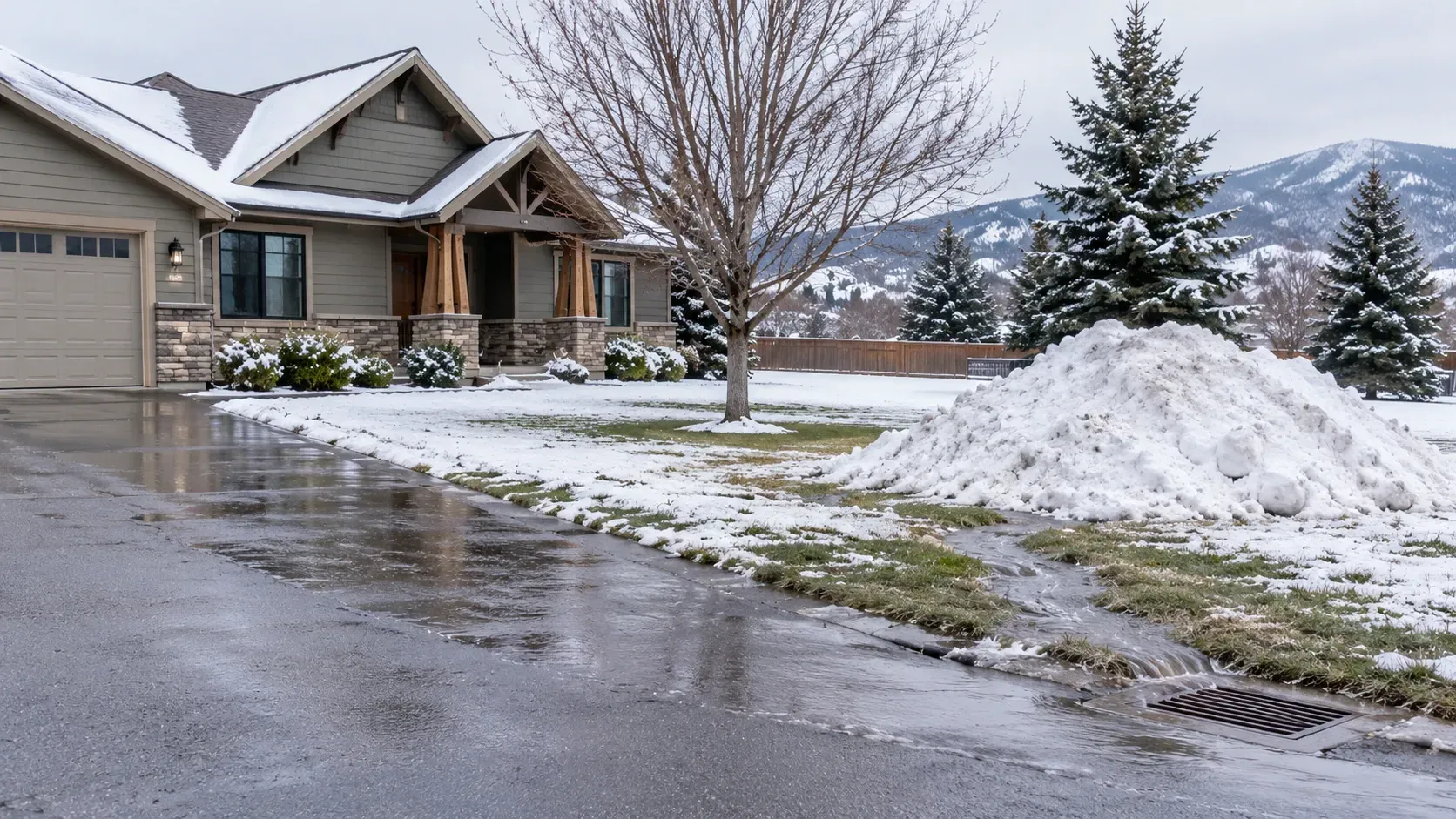
Table of Contents
- Where to Put Plowed Snow on Most Properties
- Snow Pile Placement Starts With Where Water Goes
- What Badly Placed Plowed Snow Costs You
- Why Snow Piles Kill Shrubs and Young Trees
- The Pile That Eats Your Driveway by February
- Sight Lines, the Road, and the Next Plow Pass
- Conclusion
- Want the Pile Zone Marked Before the Snow Flies?
- Frequently Asked Questions
Key Takeaways
- A snow pile is a slow-release water tank. Put it where that water already drains away.
- Downhill of the foundation and window wells, never uphill of them.
- Keep it off shrubs, off young tree trunks, and out of the septic drainfield.
- Plan for the whole season, not the first storm. The pile grows and the driveway shrinks.
- No single location works on every lot. Slope decides it.
Introduction
Pile plowed snow downhill of the foundation and the window wells, off the walkways and the shrubs, and clear of your sight line at the road, which is why our plowing and clearing plans mark the pile zone before the first storm instead of after it. Slope decides the rest. Where your yard already drains is where the melt is going to go whether you planned for it or not.
So here is the way to think about it. That pile is not snow sitting there. It is a few hundred gallons of water on a delay, and you are picking the spot where it gets released.
Where to Put Plowed Snow on Most Properties
Downhill and downwind of anything you care about, with a clear path for the water to leave.
On a typical Bitterroot Valley lot the short answer looks like this:
- Downhill of the house, so melt runs away from the foundation rather than toward it
- Away from window wells, which are the single most common place we see water get into a basement
- Off the lawn's low point, because a pile sitting in the low spot keeps that spot saturated into spring
- Clear of walkways and entries, so the afternoon melt is not refreezing across the path people use
- Off planting beds and shrub lines, which take the weight badly
- Not on the septic drainfield, where packed snow and traffic compact the ground and cost you the insulation that loose snow provides
And the honest caveat the calendar asked for, which is also just true: no pile location suits every lot. A property that slopes toward the road wants a completely different plan than one that slopes toward the house. Ours is to look first.
Snow Pile Placement Starts With Where Water Goes
You already have the information you need. You just have to go outside during a thaw and look.
This is the part we wish more homeowners did, because it takes ten minutes and it settles the question:
- Walk the property during a warm afternoon in winter, or after a good rain in fall, and watch where water actually travels
- Find the low point. There is always one, and it is usually not where people assume
- Note where downspouts discharge and where that water ends up
- Look at whether the grade near the house falls away from the foundation or toward it
Whatever path the water takes, that is your answer. Put the pile where meltwater joins that path on its way out, not where it has to cross a walkway or pond against a wall to get there.
If you already know you have yard drainage trouble, the pile placement gets more important rather than less. A property with existing drainage problems does not need several hundred extra gallons aimed at the worst spot.
What Badly Placed Plowed Snow Costs You
Four ways, and the first one is expensive.
Water in the basement. A pile stacked uphill of the house, or right against it, melts into the soil beside the foundation. Frozen ground underneath cannot absorb it, so it runs along the frost layer and finds the wall, a crack, or a window well. People blame a wet February on groundwater when the actual cause was a pile somebody put in a convenient spot in December.
Ice across the walkway. A pile that melts in the afternoon sun and runs over a path refreezes overnight into exactly the kind of sheet ice that nobody sees. This is the one with real liability attached, and it is why ice sheets form in the same places year after year.
Buried everything. Water shutoffs, meters, propane tank fill valves, electrical meters, hose bibs, the mailbox approach. We have had to dig out a propane fill on a delivery day more than once because the pile went where there was room rather than where it belonged.
Turf damage. Snow piled deep and packed hard stays into spring and comes off leaving matted, grey, moldy grass. It recovers, usually, but it recovers slowly, and you will be looking at it in April.
Why Snow Piles Kill Shrubs and Young Trees
Three separate mechanisms, and they stack.
Weight. Plowed snow is not the fluffy stuff that fell. It has been scraped, compressed and thrown. It is dense. Piled against a shrub it splays the branches outward until they split at the crotch, and arborvitae and junipers around here take that badly every single winter.
Bark damage on young trunks. A young tree with snow packed around its base stays wet at the bark line and gives voles a covered place to work. The damage is at the trunk, under the snow, and you find it when the snow goes.
What rode in with the snow. Whatever got spread on the driveway is in that snow, and when the pile melts it concentrates right there. The brown half-circle around a shrub at the end of a driveway in spring is usually this.
If a shrub has already been splayed by past winters, overgrown shrubs can often be brought back with the right cuts, but preventing it is cheaper. Move the pile instead.
The Pile That Eats Your Driveway by February
This is the mistake that separates a first-storm plan from a winter plan.
Pick a pile spot that works for one plow and by mid-season you have lost two feet of driveway width on both sides. On the long rural driveways we clear around Stevensville driveways and out toward Victor, where there is often a ditch on one side and a fence on the other, that compounds fast. By February the usable width is narrower than the truck, and the only way to fix it mid-winter is to haul snow, which costs real money.
So we plan for the season:
- Choose a spot with room for the pile to grow sideways, not just the first push
- Keep the far end of the driveway open as the overflow area
- Push back the existing pile early in the season while it is still soft, rather than trying to move a hardened one in January
- Accept that on a tight lot, one spot will not hold it all, and pick the second location now
The existing one-line advice to set up a designated pile area is right as far as it goes. This is what choosing one actually involves.
Sight Lines, the Road, and the Next Plow Pass
Two rules that matter more than the rest, and one thing you need to confirm locally.
Never pile snow where it blocks your view pulling out onto the road. A pile at the end of a driveway becomes a wall at eye height by January. Backing into a road you cannot see is a far bigger problem than a wet basement.
Never push snow into the road either. It refreezes, it becomes somebody else's hazard, and the county plow puts it straight back in your driveway on the next pass. Packed harder than when it left, usually.
What we cannot tell you in an article is the specific rule for your address. Sight-distance requirements, road right-of-way limits and any HOA restrictions on piling near a road vary from town to town, and between county and state-maintained roads. Before you commit a pile location near the road, confirm it with your town or the county road department. We work around whatever applies at around Hamilton properties and elsewhere in the valley, but the rule belongs to them and not to us.
Conclusion
Go stake it out before the first real storm. Four driveway markers at the corners of the pile zone, set after you have watched where water leaves your property, will save you more trouble this winter than any piece of equipment. Downhill of the house, off the walkways, clear of the shrubs, out of your sight line at the road, with room to grow. A pile in the right place is invisible all winter and gone by April. One in the wrong place becomes a wet basement wall, a dead shrub, or a sheet of ice across the front walk. All three cost more than the ten minutes of planning would have.
Want the Pile Zone Marked Before the Snow Flies?
We will walk your property, look at how it drains, and build a snow plan that says where the snow goes before the first push rather than after. About 25 years of winters in this valley means we have usually seen your particular drainage puzzle before. Quotes are free, our crews are experienced and trained, and we will fit the plan to your property and your budget. We clear driveways, walkways, sidewalks and business entrances, with optional de-icing available between storms. Call (406) 369-4114 or
talk to us online.
Frequently Asked Questions
Where should you not pile snow?
Uphill of the house, against the foundation, over window wells, on walkways, on the septic drainfield, on top of utility meters or propane fills, and anywhere it blocks your view of the road. Also avoid the lawn's low point, where it keeps the ground saturated into spring.
Can piled snow cause basement flooding?
Yes, and it is the most common damage we see. Frozen ground cannot absorb the melt, so water travels along the frost layer to the foundation and finds a crack or a window well. The pile is usually placed in December and blamed on groundwater in February.
Does piled snow kill shrubs?
It can. Plowed snow is dense enough to splay and split branches, it keeps young tree bark wet and gives voles cover, and whatever was spread on the driveway concentrates around the pile as it melts. Keep piles off planting beds entirely.
How much room does a snow pile need?
More than the first storm suggests. Plan for the pile to grow sideways all season and keep a second overflow spot in mind on a tight lot. Pushing the pile back early, while it is still soft, is far easier than moving a hardened one in January.
Is it illegal to push snow into the road?
Rules on piling near a road and on right-of-way vary by town and by whether the road is county or state maintained, so confirm yours locally. Either way it refreezes into a hazard and the next plow pass returns it to your driveway packed harder.