
Table of Contents
- Introduction
- Patio Installation Cost in Darby, MT: What Sets the Number
- The Base Is the Part You Cannot See
- Paver Patio Price: How Material Choice Changes Things
- What Freeze and Thaw Does to a Cheap Patio
- Drainage Is Not an Optional Extra
- Where You Can Reasonably Save
- What a Patio Installation Quote Should Spell Out
- Conclusion
- Request a Free Patio Installation Estimate
- Frequently Asked Questions
Key Takeaways
- Size and material are the obvious costs. Site prep and base are the ones that decide longevity.
- Our freeze and thaw cycles will find any shortcut taken underground.
- Pavers, concrete and natural stone each price differently and behave differently here.
- Access matters. A back yard a machine cannot reach costs more in labour.
- A quote that does not describe the base is not a quote you can compare.
Introduction
For a new patio in Darby, the budget comes down to how big it is, what you surface it with, and what has to happen to the ground underneath before anything is laid. That third one is where the money quietly goes, and it is the part that decides whether the patio is still flat after five Bitterroot winters. Every hardscaping project we build starts with carefully leveled ground for exactly that reason.
Homeowners usually come to us with a material in mind. We would rather talk about the base first, because material is the part you can change your mind about and the base is not.
Here is what actually drives the number.
Patio Installation Cost in Darby, MT: What Sets the Number
In rough order of how much each moves the budget:
- Size. The obvious one, and it scales fairly predictably.
- Excavation and base depth. How much soil comes out and what goes back in.
- Material. Pavers, concrete or natural stone, with a wide range inside each.
- Site access. Whether a machine can reach the area or everything moves by wheelbarrow.
- Slope and grading. Level sites cost less than ones that need cutting and filling.
- Drainage work. Where water needs somewhere to go.
- Edge restraint and borders. Holds the whole thing together, and borders in a contrasting material add cost.
- Pattern complexity. Intricate paver layouts take longer to lay and waste more material on cuts.
- Steps, walls or seating. Any vertical element is a separate build.
- Disposal. Spoil from excavation has to go somewhere.
Access is the one that catches people out. The same patio in a front yard a machine can drive to and a back yard behind a narrow gate are not the same job.
The Base Is the Part You Cannot See
If you take one thing from this, take this.
A patio is a surface sitting on a prepared base. The base does the structural work. Pavers and stone just sit on top looking good.
A proper build means excavating to the right depth for the conditions, putting in compacted aggregate in layers rather than all at once, setting a bedding layer, and installing edge restraint so the surface cannot creep outward over time.
Where corners get cut:
- Not digging deep enough
- Dumping aggregate in one lift rather than compacting in layers
- Skipping edge restraint
- Laying on undisturbed topsoil rather than a built base
- Ignoring drainage because the yard looks flat
None of those shows on day one. A patio built that way photographs beautifully in September. The problems arrive later, and they arrive from below.
Paver Patio Price: How Material Choice Changes Things
You can choose from a range of materials to fit your style and budget, and we help match the material to the feature, your property, the look you want, durability and budget. What that means in practice:
Pavers. The most common choice here. Durable, enormous design range from simple layouts to intricate patterns, and individually replaceable if one gets damaged or stained. Mid-range on cost, with a wide spread depending on the paver.
Concrete. Often the lowest installed cost for a plain slab. The trade is that it cracks eventually, and a crack is a repair to the whole area rather than one unit. Stamped and coloured finishes close the price gap considerably.
Natural stone. The most expensive, and the best looking. Irregular shapes mean more labour, more cutting and more waste.
A point worth making about replaceability. In a climate that moves the ground every year, being able to lift and relay a section matters more than it does somewhere mild. That is a real argument for pavers beyond how they look.
If you are still at the ideas stage, what works well in a Bitterroot back yard and patio layouts for outdoor living are both worth a look before you settle on a material.
What Freeze and Thaw Does to a Cheap Patio
This is the Darby-specific part, and it is why we are insistent about the base.
Ground here freezes and thaws repeatedly rather than staying frozen. Water in the soil expands when it freezes and the ground lifts. When it thaws, it settles back, and not always evenly.
A patio built on a properly prepared, well-drained base rides that out. A patio built on topsoil or an under-compacted base does not. What you get over a few seasons:
- Sections that sit higher or lower than their neighbours
- Edges creeping outward where there is no restraint
- Low spots that hold water, which makes the next winter worse
- Cracking across a concrete slab
- Joints opening up and filling with weeds
The repair is almost always a rebuild of the affected area, because the problem is underneath rather than on top. Paying properly for the base the first time is cheaper than paying for it twice.
Drainage Is Not an Optional Extra
Water affects soil, pavers and retaining walls over time, which is why we plan drainage on every hardscape installation rather than treating it as an add-on.
What that involves:
- A slight fall across the surface so water runs off rather than sitting
- Running water away from your foundation, not toward it
- Somewhere for it to actually go once it leaves the patio
- Base material that drains rather than holding water underneath
- Accounting for what the roof and gutters already send that way
A flat-looking yard is not the same as a yard with no water problem. If your property already has somewhere water collects after a storm, mention it early, because solving it as part of the build costs far less than solving it afterward.How drainage and landscaping work together covers the wider picture.
Where You Can Reasonably Save
Sensible places to trim:
- Build slightly smaller. Size scales directly, and most people overestimate how much they need.
- Simpler pattern. Running bond rather than herringbone means faster laying and fewer cuts.
- Skip the contrasting border, or use the same material.
- Standard pavers rather than premium or natural stone.
- Phase it. Patio now, fire feature or seating wall later, as long as the base allows for it.
- Improve access before we arrive if that is within your control.
- Book outside peak season.
Where we would not save:
- Excavation depth and base. The whole patio depends on it.
- Edge restraint. Cheap to include, expensive to add later.
- Drainage.
- Compaction. It is time, and skipping it is how patios sink.
The rule is the same one we use on every build. Economise on what you can change later. Never economise on what gets buried.
What a Patio Installation Quote Should Spell Out
Comparing two numbers only works if they describe the same job. A quote should tell you:
- Finished dimensions and total area
- Excavation depth and what is being removed
- Base material and compacted depth
- Bedding layer and jointing
- Edge restraint type
- The exact paver, concrete finish or stone, by name
- Pattern and any border
- Drainage provision and where water is going
- Spoil disposal
- Site restoration around the edges
- Timeline and what happens if weather delays it
If a quote is a size and a price, ask for the base specification. A builder who is doing it properly will be glad to tell you, because it is where their cost is.
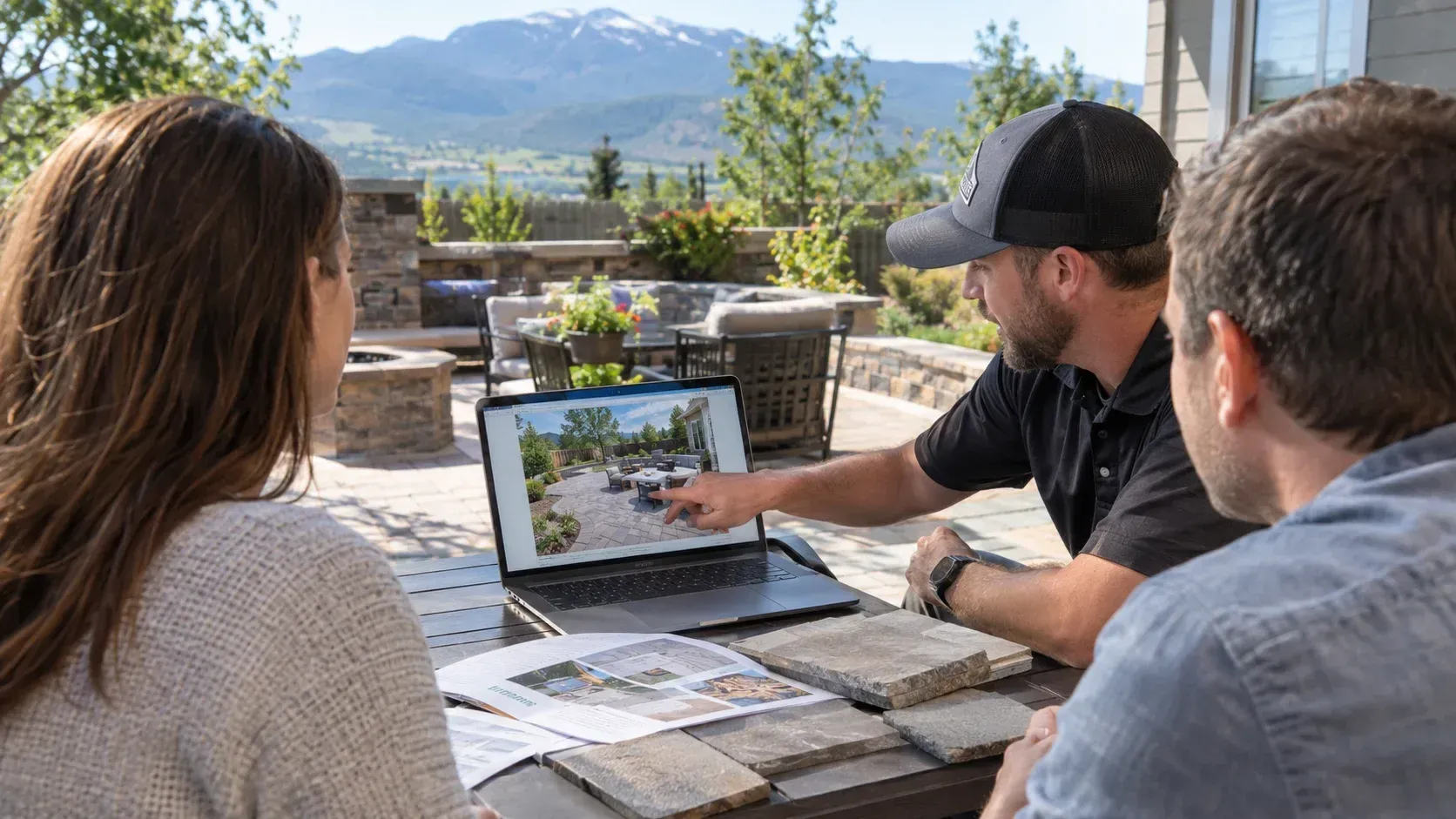
Every project we do starts with a consultation and planning, covering layout, materials and drainage so the finished project works the way it should. What other Bitterroot homeowners say is worth reading alongside any quote you are weighing.
Conclusion
Budget for a patio in Darby by thinking in two halves. The visible half is size, material and pattern, and it is the part you will enjoy choosing. The invisible half is excavation, base, compaction, edge restraint and drainage, and it is the part that decides whether you are still happy with it in a decade.
Our winters are hard on anything built on a shortcut. Freeze and thaw will find an under-compacted base, and when it does the fix is a rebuild rather than a repair.
Get quotes that describe the base. That single question tells you more about who you are hiring than the price does.
Request a Free Patio Installation Estimate
The useful starting point is someone standing in the space, looking at access, slope and where the water goes.
We design and build patios, walkways, retaining walls and custom paver work in pavers, concrete and stone. Every project starts with a consultation and planning, we level the ground carefully for even placement, and pavers, stone or concrete go in with precision for a smooth, durable surface. Free quotes and transparent pricing.
Two Brothers Lawn and Snow has roughly 25 years of experience, and we serve Darby, Hamilton, Corvallis, Victor, Stevensville and the surrounding Bitterroot Valley. We offer free on-site assessments for all of our services.
Reach out and tell us roughly what size you have in mind and how a machine would reach space, or call
(406) 369-4114.
Frequently Asked Questions
Can you give me a price per square foot?
Only as a rough sense of scale. Excavation depth, access, slope, drainage and material all move the number, and two patios of identical size on the same street can price very differently. A site visit gives you something you can rely on.
Are pavers or concrete cheaper?
Plain concrete is often lower to install. Pavers tend to last better through freeze and thaw and individual units can be lifted and relaid, which matters here. Stamped concrete narrows the price gap considerably.
Why does the base cost so much when you cannot see it?
Because it is doing the structural work. Excavation, compacted aggregate in layers and edge restraint are what stop a patio moving through winter. Skipping base work is the main reason patios need rebuilding.
Can I build the patio now and add a seating wall later?
Usually yes, if we plan for it at the start. Tell us about future plans during the consultation so the base and layout allow for it rather than needing rework.
Does a patio need drainage if my yard is flat?
Yes. Flat-looking yards still collect water, and a patio changes where runoff goes. We plan a fall across the surface and somewhere for water to drain on every installation.